2. Microtubules
Example 2: HeLa microtubule
In this example we used Warp, AreTomo3, easymode, Relion5, and M to reconstruct, denoise, segment, pick, and average microtubules in HeLa cells.
Dataset and computational resources
For this test we used 621 tilt series of FIB-milled HeLa cells which we collected ourselves. They are not yet available online but hopefully will be soon.
We used 4 NVIDIA RTX 4090 GPUs for most processing steps.
At the onset the data in this example consisted of just tilt series and mdocs (we did not use the gain references). Pixel size was 1.56 Å/px, dose 4.6 e⁻/Ų per tilt (150 e⁻/Ų total), dose-symmetric tilt series of ±45° with 3° increments.
project_root/
├── frames/        # 621 x 31 =  19282 .tif files
│   ├── 250531_l1p1_001_-10.0_20250531_093402.tif
│   ├── 250531_l1p1_001_-7.0_20250531_093438.tif
│   └── ...
└── mdocs/         # 621 .mdoc files
    ├── 250531_l1p1.mdoc
    ├── 250531_l1p1_2.mdoc
    └── ...
Step 1: tomogram reconstruction
easymode reconstruct --frames frames --mdocs mdocs --apix 1.56 --dose 4.6 --no_halfmaps
warp_tiltseries/reconstruction/.
Step 2: tomogram denoising
easymode denoise --data warp_tiltseries/reconstruction --output warp_tiltseries/reconstruction/denoised --method n2n --gpu 0,1,2,3
warp_tiltseries/reconstruction/denoised/.
Step 3: microtubule segmentation
easymode segment microtubule --data warp_tiltseries/reconstruction/denoised --output segmented --gpu 0,1,2,3
Step 4: vectorizing microtubule instances & generating coordinates
easymode pick microtubule --data segmented --output coordinates/microtubule --length 1000 --spacing 200 --filament --separate_filaments
Step 5: per-filament averaging
Update 2026/06/19 - per-filament averaging is no longer necessary.
In previous versions of WarpTools, any custom columns in a particle .star file would get ignored during ts_export_particles. This meant that starfiles coming from easymode pick --filament, where every particle has an aisFilamentID tag that links it to its parent filament, would lose important information. Because of that, we did per-filament averaging.
This issue has now been fixed and WarpTools will retain any custom headers. Rather than per-filament averaging, it is now possible and much easier to do the following:
- Use a 3D classification job with two classes. With good picks, the one class will end up representing a microtubule running in
+z, the other rotated 180° and running in-z. - Use a Python script to apply the per-filament orientation consensus:
- For every
aisFilamentIDvalue in the classification output starfile (e.g.Class3D/run_it025_data.star), measure whetherrlnClassNumber1 orrlnClassNumber2 is the majority (e.g. >70% vote). - In the original filament .starfile (from picking, before averaging): for every filament where
rlnClassNumber=2was the majority, flip the rlnAngleTilt and rlnAnglePsi. - Discard filaments where there is no
rlnClassNumberconsensus (e.g. neither class is >70%). In rare cases we've seen a 50:50 split; it can help to check the curvature of such filaments: when the overall curvature is low, but there are a few particles withaisRadiusOfCurvaturehigh, it often means two separate microtubules accidentally got traced as a single one.
- For every
- Output a new starfile, where the consensus has been applied such that
rlnAngleTiltis now consistent with microtubule polarity. We prefer to adjust the angles in the original starfile resulting from picking, rather than in the output starfile from the classification. That gives you a fixed source of initial particles, respecting polarity, to enter STA processing with.
A tricky thing about microtubules is that they have a distinct polarity, but when parsing euler angles from the tangent to the filament you can't yet take this polarity in to account. So when you use the resulting euler angles (which may be off by 180°) you end up with a microtubule-like mixed polarity tube. A second problem is that while microtubules mostly have 13 protofilaments, they can also sometimes have 12 or 14 or some other number. For best STA results you would have to separate out the particles from filaments with different protofilament numbers. We do this via per-filament STA and determining the polarity and protofilament number based on the resulting averages. This per-filament averaging is a bit awkward, so we used a script to automate it:
Per-filament averaging script
import os, glob, subprocess, json, starfile
import numpy as np, mrcfile

ROOT = '/cephfs/mlast/em/HeLa_MPA_merged'
MICRO = f'{ROOT}/MICROTUBULE'              # all per-filament work lives here
POLARITY = f'{MICRO}/polarity_maps'        # output maps
REF = f'{MICRO}/emd_7973.mrc'              # reference

# create the shared output dirs once, up front
os.makedirs(MICRO, exist_ok=True)
os.makedirs(POLARITY, exist_ok=True)


def _run(cmd, capture=False):
    print(f'\033[42m{cmd}\033[0m\n')
    ret = subprocess.run(cmd, shell=True, capture_output=capture, text=True if capture else None)
    if ret.returncode != 0:
        print(f'\033[91merror running {cmd}\033[0m')
    return ret.stdout


def _abs(p):
    """Make a star-file path absolute (idempotent): WarpTools writes paths relative to ROOT."""
    return p if os.path.isabs(p) else f'{ROOT}/{p}'


filaments = sorted(glob.glob(f'{ROOT}/coordinates/microtubule/*.star'))
filaments = sorted(filaments, key=lambda x: os.path.getsize(x), reverse=True)

for f in filaments:
    try:
        name = os.path.basename(os.path.splitext(f)[0])
        work = f'{MICRO}/{name}'                       # this filament's working dir
        job = f'{work}/Refine3D/job001'
        os.makedirs(work, exist_ok=True)

        if os.path.exists(f'{job}/run_data.star'):
            print(f'skipping {name}')
        else:
            particles = starfile.read(f)
            if len(particles) < 10:
                continue
            tomostar = os.path.basename(particles['rlnMicrographName'][0])

            # STEP 1 - export particles with WarpTools (all paths absolute; cwd irrelevant)
            if not os.path.exists(f'{work}/particles.star'):
                os.makedirs(f'{work}/particles', exist_ok=True)
                os.chdir(ROOT)
                _run(f"WarpTools ts_export_particles --perdevice 4 "
                    f"--input_data {ROOT}/tomostar/{tomostar} "
                    f"--settings {ROOT}/warp_tiltseries.settings "
                    f"--input_star {f} --coords_angpix 10.0 --output_angpix 5.0 "
                    f"--box 64 --diameter 300 --3d "
                    f"--output_star {work}/particles.star "
                    f"--output_processing {work}/particles")

                # rewrite image/ctf paths to absolute so relion finds them from any cwd
                star_data = starfile.read(f'{work}/particles.star')
                star_data['rlnImageName'] = [_abs(p) for p in star_data['rlnImageName']]
                star_data['rlnCtfImage'] = [_abs(p) for p in star_data['rlnCtfImage']]
                starfile.write(star_data, f'{work}/particles.star', overwrite=True)

            # STEP 2 - Relion 3D auto-refine (run from the filament dir; uses relative --o/--i)
            os.makedirs(job, exist_ok=True)
            os.chdir(work)
            _run('mpirun -n 5 --oversubscribe relion_refine_mpi '
                '--sym C1 '
                '--o Refine3D/job001/run '
                '--auto_refine '
                '--split_random_halves '
                '--i particles.star '
                '--sigma_tilt 30 '
                f'--ref {REF} '
                '--firstiter_cc '
                '--trust_ref_size '
                '--ini_high 90 '
                '--pool 3 '
                '--pad 2  '
                '--ctf '
                '--particle_diameter 300 '
                '--flatten_solvent '
                '--zero_mask '
                '--oversampling 1 '
                '--healpix_order 1 '
                '--auto_local_healpix_order 1 '
                '--offset_range 3 '
                '--offset_step 1 '
                '--low_resol_join_halves 40 '
                '--norm '
                '--scale  '
                '--j 14 '
                '--gpu ""  '
                '--pipeline_control Refine3D/job001/')

        # STEP 3 - polarity map from the last refinement iteration
        its = sorted(glob.glob(f'{job}/run_it*_half1_class001.mrc'))
        if not its:
            print(f'no refinement output for {name}, skipping polarity map')
            continue
        vol = mrcfile.read(its[-1])
        c = vol.shape[0] // 2                           # center slab, robust to box size
        polarity_map = vol[c - 12:c + 12, :, :].mean(axis=0)
        with mrcfile.new(f'{POLARITY}/{name}.mrc', overwrite=True) as mrc:
            mrc.set_data(polarity_map.astype(np.float32))
    except Exception as e:
        print(f'{name}: {e}')
You could also run a variation of this script with C13 symmetry enforced in the Refine3D job. For filaments that do have 13 protofilaments, this helps to accentuate the polarity in the resulting averages. Or even running it three times, once with C12, C13, and C14 symmetry, to figure out the polarity and the number of protofilaments. To adapt this script to your situation, you might want to copy it into an LLM and ask for guidance.
This script saved the averages of each individual filament to polarity_maps/, which in this case we visually inspected to select a subset of 13-protofilament filaments with known polarity.
Step 6: global averaging
We then pooled all particles found in filaments that clearly had 13 protofilaments and a consistent polarity (rotating the angles by 180 degrees for those particles that were inverted relative to the reference). This yielded ~3800 particles, which were roughly aligned. We exported these at 5 Å/px using WarpTools ts_export_particles and ran a Relion5 Refine3D job which quickly reached ~10 Å resolution.
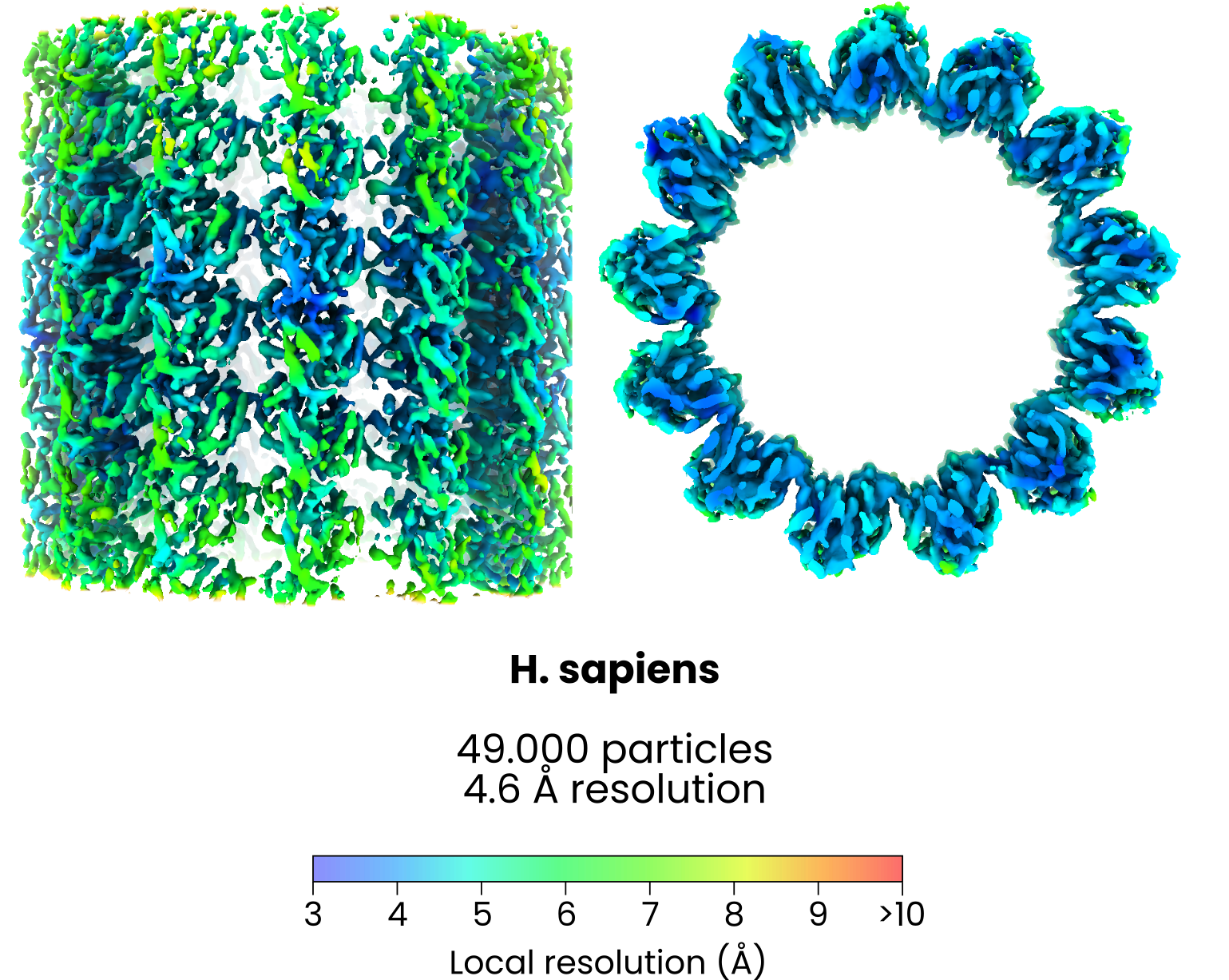
Finally, we used ChimeraX and the 10 Å average to position 13 cropped alpha beta tubulin monomers in the map, sampled the translation and orientation of each monomer relative to the center of the full map, applied the resulting transformation matrices to the .star file (generating 13 new particles for each original 1 particle), and ran refinement in M. This reached 4.6 Å. The subboxing was done with our ChimeraX-subboxer plugin.
Note
It should also be possible to average all particles at once rather than doing per-filament subtomogram averaging first. For instance, running a single Relion5 Refine3D job with 30° of freedom around the prior gives a well aligned mixed-polarity average. Next, a 3D classification with 2 classes works to mostly separate the two polarities (especially when enforcing a C13 symmetry - which is not good for final averaging, but does help to accentuate the polarity in the microtubule cross-sections). Finally, correcting for the opposing polarities and pooling both classes should allow for averaging to decent resolution; we got to 8 Å this way in M but then got stuck. Perhaps another round of classification, using 12-, 13-, and 14-protofilament references, would have helped to sort out the particles at that point; but by then we had already had more success with the somewhat awkward per-filament averaging approach. Classification is also not guaranteed to separate the polarities completely, so you may end up with contradictory orientations even within one filament. A third option would be to use helical refinement - we didn't try this.